
使用 PyTorch 的 Seq2seq(序列到序列)模型
 Evelyn Clarke
 什么是 NLP?
NLP 或自然语言处理是人工智能的一个热门分支,它帮助计算机以人类的自然语言来理解、处理或响应。NLP 是 Google 翻译的引擎,帮助我们理解其他语言。
什么是 Seq2Seq?
Seq2Seq 是一种基于编码器-解码器的机器翻译和语言处理方法,它将一个序列的输入映射到一个带有标签和注意力值的序列输出。其思想是使用 2 个 RNN,它们协同工作,并带有特殊标记,尝试从前一个序列预测下一个状态序列。
如何从前一个序列预测序列
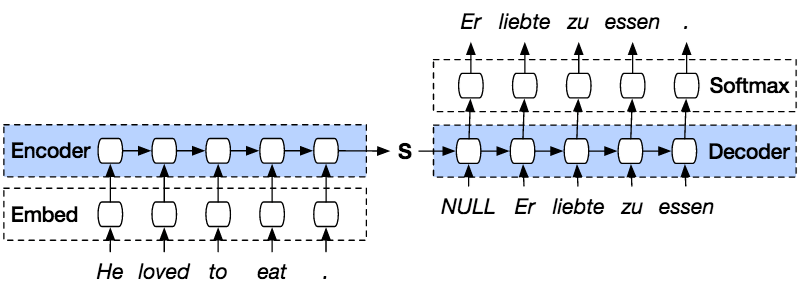
以下是使用 PyTorch 从前一个序列预测序列的步骤。
第 1 步)加载我们的数据
对于我们的数据集,您将使用来自 制表符分隔的双语句子对的数据集。在这里,我将使用英语到印度尼西亚语的数据集。您可以选择任何您喜欢的,但请记住在代码中更改文件名和目录。
from __future__ import unicode_literals, print_function, division
import torch
import torch.nn as nn
import torch.optim as optim
import torch.nn.functional as F

import numpy as np
import pandas as pd

import os
import re
import random

device = torch.device("cuda" if torch.cuda.is_available() else "cpu")
第 2 步)数据准备
您不能直接使用数据集。您需要将句子拆分成单词,并将其转换为独热编码。Lang 类中的每个单词都将被唯一地索引以创建字典。Lang 类将存储每个句子,并将其按单词拆分,通过 addSentence。然后通过为序列到序列模型索引每个未知词来创建字典。
SOS_token = 0
EOS_token = 1
MAX_LENGTH = 20

#initialize Lang Class
class Lang:
   def __init__(self):
       #initialize containers to hold the words and corresponding index
       self.word2index = {}
       self.word2count = {}
       self.index2word = {0: "SOS", 1: "EOS"}
       self.n_words = 2  # Count SOS and EOS

#split a sentence into words and add it to the container
   def addSentence(self, sentence):
       for word in sentence.split(' '):
           self.addWord(word)

#If the word is not in the container, the word will be added to it,
#else, update the word counter
   def addWord(self, word):
       if word not in self.word2index:
           self.word2index[word] = self.n_words
           self.word2count[word] = 1
           self.index2word[self.n_words] = word
           self.n_words += 1
       else:
           self.word2count[word] += 1
Lang 类是一个将帮助我们创建字典的类。对于每种语言,每个句子都将被拆分成单词,然后添加到容器中。每个容器将以适当的索引存储单词,计算单词的计数,并添加单词的索引,以便我们可以使用它来查找单词的索引或通过其索引查找单词。
因为我们的数据是用 TAB 分隔的,所以您需要使用 pandas 作为我们的数据加载器。Pandas 将读取我们的数据作为数据框,并将其拆分成源句子和目标句子。对于您拥有的每个句子,
- 您将将其规范化为小写,
- 删除所有非字符
- 将 Unicode 转换为 ASCII
- 拆分句子,这样您就能得到其中的每个单词。
#Normalize every sentence
def normalize_sentence(df, lang):
   sentence = df[lang].str.lower()
   sentence = sentence.str.replace('[^A-Za-z\s]+', '')
   sentence = sentence.str.normalize('NFD')
   sentence = sentence.str.encode('ascii', errors='ignore').str.decode('utf-8')
   return sentence

def read_sentence(df, lang1, lang2):
   sentence1 = normalize_sentence(df, lang1)
   sentence2 = normalize_sentence(df, lang2)
   return sentence1, sentence2

def read_file(loc, lang1, lang2):
   df = pd.read_csv(loc, delimiter='\t', header=None, names=[lang1, lang2])
   return df

def process_data(lang1,lang2):
   df = read_file('text/%s-%s.txt' % (lang1, lang2), lang1, lang2)
   print("Read %s sentence pairs" % len(df))
   sentence1, sentence2 = read_sentence(df, lang1, lang2)

   source = Lang()
   target = Lang()
   pairs = []
   for i in range(len(df)):
       if len(sentence1[i].split(' ')) < MAX_LENGTH and len(sentence2[i].split(' ')) < MAX_LENGTH:
           full = [sentence1[i], sentence2[i]]
           source.addSentence(sentence1[i])
           target.addSentence(sentence2[i])
           pairs.append(full)

   return source, target, pairs
您将使用的另一个有用函数是将对转换为张量。这非常重要,因为我们的网络只读取张量类型的数据。这也很重要,因为这是在每个句子末尾都会有一个标记来告诉网络输入已完成的部分。对于句子中的每个单词,它将从字典中相应的单词获取索引,并在句子末尾添加一个标记。
def indexesFromSentence(lang, sentence):
   return [lang.word2index[word] for word in sentence.split(' ')]

def tensorFromSentence(lang, sentence):
   indexes = indexesFromSentence(lang, sentence)
   indexes.append(EOS_token)
   return torch.tensor(indexes, dtype=torch.long, device=device).view(-1, 1)

def tensorsFromPair(input_lang, output_lang, pair):
   input_tensor = tensorFromSentence(input_lang, pair[0])
   target_tensor = tensorFromSentence(output_lang, pair[1])
   return (input_tensor, target_tensor)
Seq2Seq 模型
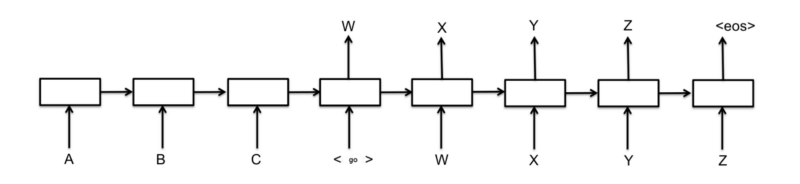
PyTorch Seq2seq 模型是一种在模型之上使用 PyTorch 编码器-解码器的模型。编码器将句子逐字编码为词汇表或已知词(带索引)的索引,解码器将通过按序列解码输入来预测编码输入的输出,并尝试使用最后一个输入作为下一个输入(如果可能)。通过这种方法,也可以预测下一个输入来创建句子。每个句子都会被分配一个标记来标记序列的结束。在预测结束时,还会有一个标记来标记输出的结束。因此,从编码器,它将把一个状态传递给解码器来预测输出。
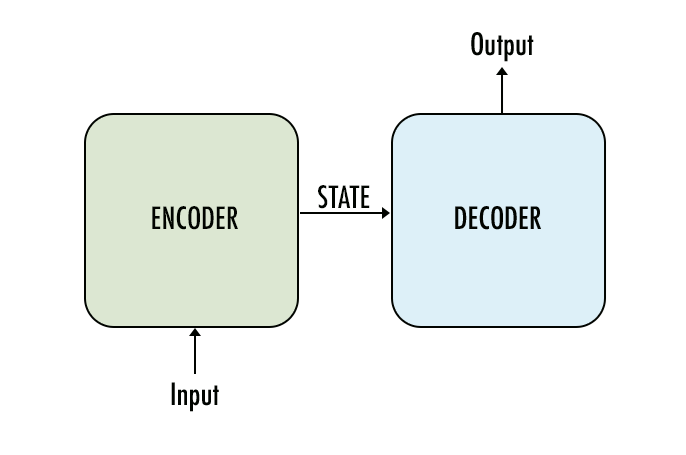
编码器将按顺序逐字编码我们的输入句子,最后会有一个标记来标记句子的结束。编码器包含一个嵌入层和一个 GRU 层。嵌入层是一个查找表,它将我们的输入嵌入到一个固定大小的单词字典中。它将被传递到一个 GRU 层。GRU 层是门控循环单元,它由多种类型的 RNN 组成,用于计算序列输入。此层将从前一个计算隐藏状态,并更新重置、更新和新的门。
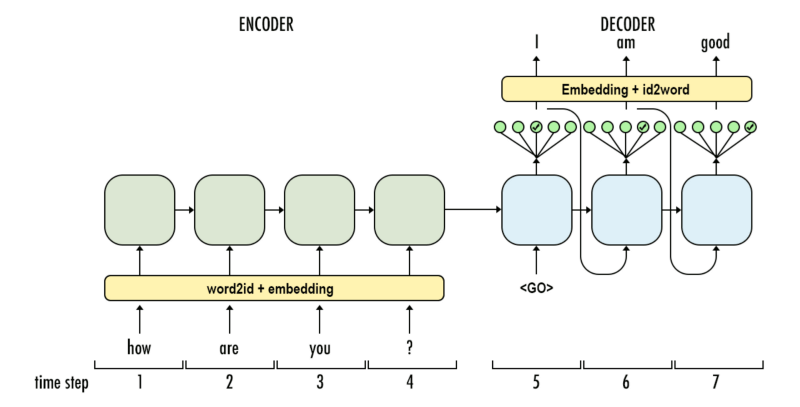
解码器将解码来自编码器输出的输入。它将尝试预测下一个输出,并尝试将其作为下一个输入(如果可能)。解码器包含一个嵌入层、一个 GRU 层和一个线性层。嵌入层将为输出创建一个查找表,并将其传递到 GRU 层以计算预测的输出状态。之后,一个线性层将有助于计算激活函数,以确定预测输出的真实值。
class Encoder(nn.Module):
   def __init__(self, input_dim, hidden_dim, embbed_dim, num_layers):
       super(Encoder, self).__init__()

       #set the encoder input dimesion , embbed dimesion, hidden dimesion, and number of layers
       self.input_dim = input_dim
       self.embbed_dim = embbed_dim
       self.hidden_dim = hidden_dim
       self.num_layers = num_layers

       #initialize the embedding layer with input and embbed dimention
       self.embedding = nn.Embedding(input_dim, self.embbed_dim)
       #intialize the GRU to take the input dimetion of embbed, and output dimention of hidden and
       #set the number of gru layers
       self.gru = nn.GRU(self.embbed_dim, self.hidden_dim, num_layers=self.num_layers)

   def forward(self, src):

       embedded = self.embedding(src).view(1,1,-1)
       outputs, hidden = self.gru(embedded)
       return outputs, hidden

class Decoder(nn.Module):
   def __init__(self, output_dim, hidden_dim, embbed_dim, num_layers):
       super(Decoder, self).__init__()

#set the encoder output dimension, embed dimension, hidden dimension, and number of layers
       self.embbed_dim = embbed_dim
       self.hidden_dim = hidden_dim
       self.output_dim = output_dim
       self.num_layers = num_layers

# initialize every layer with the appropriate dimension. For the decoder layer, it will consist of an embedding, GRU, a Linear layer and a Log softmax activation function.
       self.embedding = nn.Embedding(output_dim, self.embbed_dim)
       self.gru = nn.GRU(self.embbed_dim, self.hidden_dim, num_layers=self.num_layers)
       self.out = nn.Linear(self.hidden_dim, output_dim)
       self.softmax = nn.LogSoftmax(dim=1)

   def forward(self, input, hidden):

# reshape the input to (1, batch_size)
       input = input.view(1, -1)
       embedded = F.relu(self.embedding(input))
       output, hidden = self.gru(embedded, hidden)
       prediction = self.softmax(self.out(output[0]))

       return prediction, hidden

class Seq2Seq(nn.Module):
   def __init__(self, encoder, decoder, device, MAX_LENGTH=MAX_LENGTH):
       super().__init__()

#initialize the encoder and decoder
       self.encoder = encoder
       self.decoder = decoder
       self.device = device

   def forward(self, source, target, teacher_forcing_ratio=0.5):

       input_length = source.size(0) #get the input length (number of words in sentence)
       batch_size = target.shape[1]
       target_length = target.shape[0]
       vocab_size = self.decoder.output_dim

#initialize a variable to hold the predicted outputs
       outputs = torch.zeros(target_length, batch_size, vocab_size).to(self.device)

#encode every word in a sentence
       for i in range(input_length):
           encoder_output, encoder_hidden = self.encoder(source[i])

#use the encoder’s hidden layer as the decoder hidden
       decoder_hidden = encoder_hidden.to(device)

#add a token before the first predicted word
       decoder_input = torch.tensor([SOS_token], device=device)  # SOS

#topk is used to get the top K value over a list
#predict the output word from the current target word. If we enable the teaching force,  then the #next decoder input is the next word, else, use the decoder output highest value.

       for t in range(target_length):
           decoder_output, decoder_hidden = self.decoder(decoder_input, decoder_hidden)
           outputs[t] = decoder_output
           teacher_force = random.random() < teacher_forcing_ratio
           topv, topi = decoder_output.topk(1)
           input = (target[t] if teacher_force else topi)
           if(teacher_force == False and input.item() == EOS_token):
               break

       return outputs
第 3 步)训练模型
Seq2seq 模型中的训练过程从将每个句子对从其 Lang 索引转换为张量开始。我们的序列到序列模型将使用 SGD 作为优化器,并使用 NLLLoss 函数来计算损失。训练过程开始时,将句子对输入模型以预测正确的输出。在每一步,模型输出将与真实单词进行计算以找出损失并更新参数。因此,因为您将使用 75000 次迭代,所以我们的序列到序列模型将从我们的数据集中生成 75000 个随机对。
teacher_forcing_ratio = 0.5

def clacModel(model, input_tensor, target_tensor, model_optimizer, criterion):
   model_optimizer.zero_grad()

   input_length = input_tensor.size(0)
   loss = 0
   epoch_loss = 0
   # print(input_tensor.shape)

   output = model(input_tensor, target_tensor)

   num_iter = output.size(0)
   print(num_iter)

#calculate the loss from a predicted sentence with the expected result
   for ot in range(num_iter):
       loss += criterion(output[ot], target_tensor[ot])

   loss.backward()
   model_optimizer.step()
   epoch_loss = loss.item() / num_iter

   return epoch_loss

def trainModel(model, source, target, pairs, num_iteration=20000):
   model.train()

   optimizer = optim.SGD(model.parameters(), lr=0.01)
   criterion = nn.NLLLoss()
   total_loss_iterations = 0

   training_pairs = [tensorsFromPair(source, target, random.choice(pairs))
                     for i in range(num_iteration)]

   for iter in range(1, num_iteration+1):
       training_pair = training_pairs[iter - 1]
       input_tensor = training_pair[0]
       target_tensor = training_pair[1]

       loss = clacModel(model, input_tensor, target_tensor, optimizer, criterion)

       total_loss_iterations += loss

       if iter % 5000 == 0:
           avarage_loss= total_loss_iterations / 5000
           total_loss_iterations = 0
           print('%d %.4f' % (iter, avarage_loss))

   torch.save(model.state_dict(), 'mytraining.pt')
   return model
第 4 步)测试模型
Seq2seq PyTorch 的评估过程是检查模型输出。序列到序列模型的每个对都将被输入模型并生成预测的单词。之后,您将查看每个输出的最高值以找到正确的索引。最后,您将进行比较,看看我们的模型预测与真实句子。
def evaluate(model, input_lang, output_lang, sentences, max_length=MAX_LENGTH):
   with torch.no_grad():
       input_tensor = tensorFromSentence(input_lang, sentences[0])
       output_tensor = tensorFromSentence(output_lang, sentences[1])

       decoded_words = []

       output = model(input_tensor, output_tensor)
       # print(output_tensor)

       for ot in range(output.size(0)):
           topv, topi = output[ot].topk(1)
           # print(topi)

           if topi[0].item() == EOS_token:
               decoded_words.append('<EOS>')
               break
           else:
               decoded_words.append(output_lang.index2word[topi[0].item()])
   return decoded_words

def evaluateRandomly(model, source, target, pairs, n=10):
   for i in range(n):
       pair = random.choice(pairs)
       print(‘source {}’.format(pair[0]))
       print(‘target {}’.format(pair[1]))
       output_words = evaluate(model, source, target, pair)
       output_sentence = ' '.join(output_words)
       print(‘predicted {}’.format(output_sentence))
现在,让我们开始使用 Seq to Seq 进行训练,迭代次数为 75000 次,RNN 层数为 1 层,隐藏大小为 512。
lang1 = 'eng'
lang2 = 'ind'
source, target, pairs = process_data(lang1, lang2)

randomize = random.choice(pairs)
print('random sentence {}'.format(randomize))

#print number of words
input_size = source.n_words
output_size = target.n_words
print('Input : {} Output : {}'.format(input_size, output_size))

embed_size = 256
hidden_size = 512
num_layers = 1
num_iteration = 100000

#create encoder-decoder model
encoder = Encoder(input_size, hidden_size, embed_size, num_layers)
decoder = Decoder(output_size, hidden_size, embed_size, num_layers)

model = Seq2Seq(encoder, decoder, device).to(device)

#print model
print(encoder)
print(decoder)

model = trainModel(model, source, target, pairs, num_iteration)
evaluateRandomly(model, source, target, pairs)
如您所见,我们的预测句子匹配得不太好,因此为了获得更高的准确率,您需要使用更多数据进行训练,并尝试添加更多迭代次数和层数来学习序列到序列。
random sentence ['tom is finishing his work', 'tom sedang menyelesaikan pekerjaannya']
Input : 3551 Output : 4253
Encoder(
  (embedding): Embedding(3551, 256)
  (gru): GRU(256, 512)
)
Decoder(
  (embedding): Embedding(4253, 256)
  (gru): GRU(256, 512)
  (out): Linear(in_features=512, out_features=4253, bias=True)
  (softmax): LogSoftmax()
)
Seq2Seq(
  (encoder): Encoder(
    (embedding): Embedding(3551, 256)
    (gru): GRU(256, 512)
  )
  (decoder): Decoder(
    (embedding): Embedding(4253, 256)
    (gru): GRU(256, 512)
    (out): Linear(in_features=512, out_features=4253, bias=True)
    (softmax): LogSoftmax()
  )
)

5000 4.0906
10000 3.9129
15000 3.8171
20000 3.8369
25000 3.8199
30000 3.7957
35000 3.8037
40000 3.8098
45000 3.7530
50000 3.7119
55000 3.7263
60000 3.6933
65000 3.6840
70000 3.7058
75000 3.7044

> this is worth one million yen
= ini senilai satu juta yen
< tom sangat satu juta yen <EOS>

> she got good grades in english
= dia mendapatkan nilai bagus dalam bahasa inggris
< tom meminta nilai bagus dalam bahasa inggris <EOS>

> put in a little more sugar
= tambahkan sedikit gula
< tom tidak <EOS>

> are you a japanese student
= apakah kamu siswa dari jepang
< tom kamu memiliki yang jepang <EOS>

> i apologize for having to leave
= saya meminta maaf karena harus pergi
< tom tidak maaf karena harus pergi ke

> he isnt here is he
= dia tidak ada di sini kan
< tom tidak <EOS>

> speaking about trips have you ever been to kobe
= berbicara tentang wisata apa kau pernah ke kobe
< tom tidak <EOS>

> tom bought me roses
= tom membelikanku bunga mawar
< tom tidak bunga mawar <EOS>

> no one was more surprised than tom
= tidak ada seorangpun yang lebih terkejut dari tom
< tom ada orang yang lebih terkejut <EOS>

> i thought it was true
= aku kira itu benar adanya
< tom tidak <EOS>
